Service Year Awards · buyer guide
Recognition wording for returning employees
A returning employee’s service award should carry the employer-approved milestone or appreciation message. Service Year Awards buyers worldwide can use a numeric service statement or wording without a year count. Confirm that decision with the program owner; a first start date and a return date alone do not establish continuous service.
Reviewed 2026-09-05 · AI-assisted editorial review. General buying guidance; illustrative scenarios are not customer case studies. Images are AI-generated concepts.
A warm message can acknowledge a person's contribution without publishing details of a break in employment. Keep internal explanations and personnel notes out of the artwork. The recipient's approved display name, recognition title and chosen date or milestone are usually more useful production inputs than the underlying employment record.
Do milestone products establish how service is counted?
Milestone product categories can suggest a format, but the employer must approve how a returning employee’s service is described. Awards.com discusses five-year, ten-year and later recognition in its service-award guide. Those categories do not establish whether an employment break counts toward the service statement on this particular piece.
Separate the program's decision from the design brief. The employer's responsible contact should identify the approved milestone and wording, while the design team works out how to present it. A catalog description such as years of service is not evidence that separated periods should be added together or that a particular return date should reset the count.
If the organization has not resolved the service statement, mark that field as pending and continue only with preparation that does not depend on it. You can consider the general object style or collect an approved display name while holding the numeric tenure line. This prevents a provisional calculation from becoming a permanent inscription simply because the artwork looked finished.

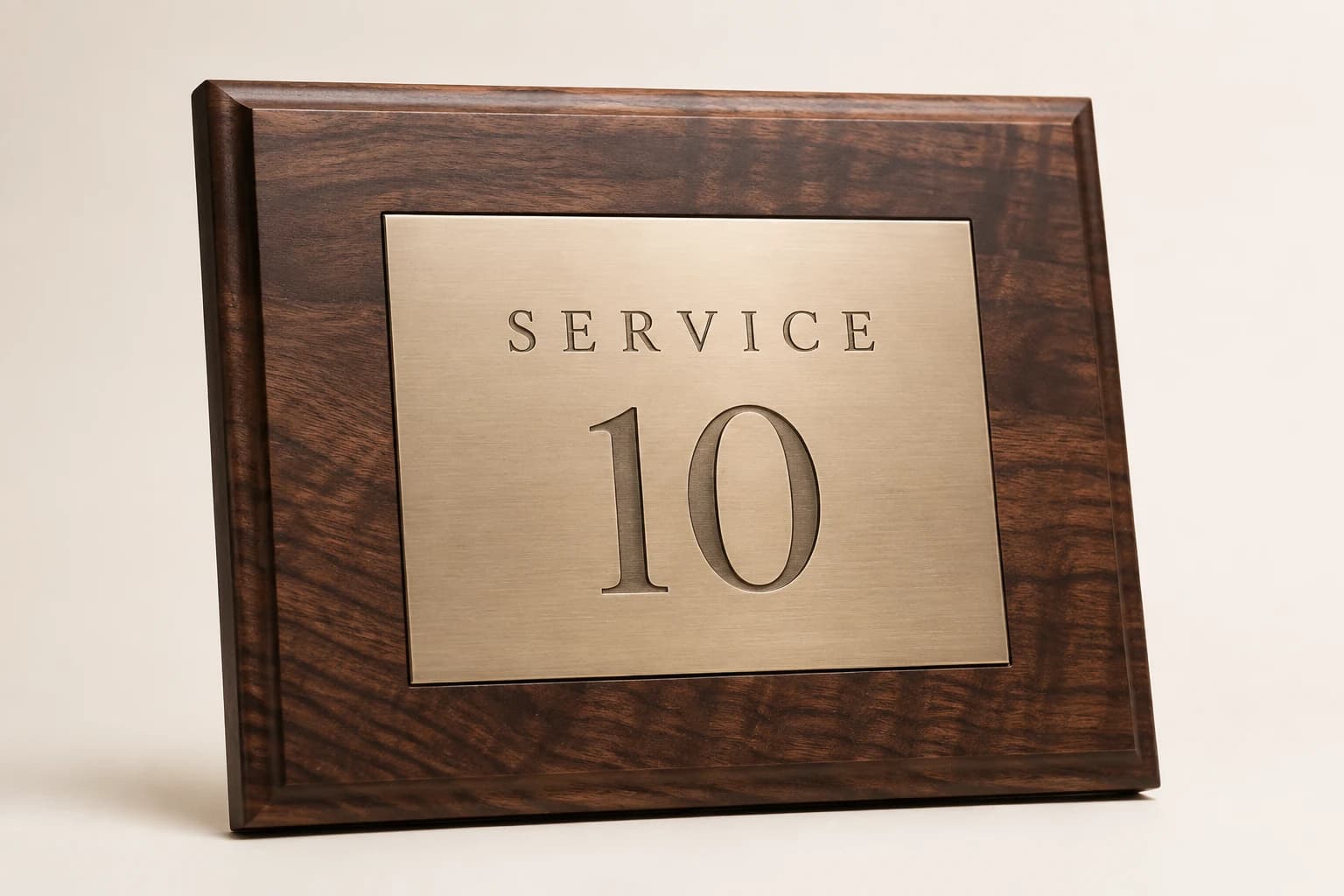
Sources: Awards.com: Years of Service & Anniversary Awards Guide
Which date belongs on a returning employee’s award?
A first start date, a return date, an anniversary date and a presentation date can all be relevant to internal planning, but they are not interchangeable. If a date appears on the award, record its intended meaning and the exact public format approved by the program owner. Do not assume that the earliest date is the one to engrave.
Avoid presenting a date range that implies continuous service unless the employer has approved that statement for the recipient. Two endpoint dates alone can communicate more than the organization intends. If a numerical claim is unnecessary, an approved appreciation message and presentation year may be a better expression of the occasion.
Keep the production file limited to the approved public information. A designer does not need the reason for a departure or details of an employment arrangement to place a service line on a plaque. Retain that background in the employer's own authorized records, and provide a clear instruction about the words that should appear.
How do you write appreciation without private employment details?
Ask what the organization wants the recipient to feel recognized for: contribution, expertise, collaboration or another approved quality. Use language specific enough to carry that appreciation without inventing an achievement or describing private circumstances. A line about continued contribution can be appropriate only when the program owner chooses it for the actual occasion.
Avoid making the return itself sound like an explanation that the recipient must accept publicly. The organization may wish to welcome someone back, recognize a later service milestone or thank them for a completed project. Those are different messages. Decide which one belongs on the object instead of combining every possible sentiment into an overcrowded inscription.
If several people receive awards in one ceremony, keep the program title and general presentation respectful and coherent. A returning employee should not receive an improvised disclaimer on their plaque because the coordinator is uncertain about a service calculation. Resolve the uncertainty privately and provide an approved message that stands on its own.


Illustrative example: how do milestone and appreciation inscriptions differ?
A fictional cycle includes four returning employees with an employer-approved milestone and two receiving appreciation without a year count. Compare the wording before counting the six plaques. A milestone line makes a service statement; a contribution message can express thanks without asserting how the employer counted separate periods of employment.
For the fictional milestone group, an optional draft is “Five Years of Service / [Approved display name] / [Presentation year]”. For the appreciation group, compare “With appreciation for your contribution / [Approved display name] / [Presentation year]”. Slashes indicate proposed line breaks, not engraving characters. These are sample copy choices for review, not actual employee records or an employer policy. The final names, year and complete message still need approval.
If the employer specifically authorizes cumulative recognition, compare the optional wording “Recognizing ten years of total service” with a continuous-looking date range. The fuller phrase makes the intended total explicit, but should be used only when the responsible employer contact confirms that exact statement. A welcome-back message would mark another occasion. Do not add it to either sample unless that is the public acknowledgment the organization actually wants.
The original physical count is unchanged: four milestone plaques plus two appreciation plaques equals six. The optional calculator checks that inventory only. The worksheet now includes the two sample inscription patterns and blank item fields for the final name, message, date meaning and approval reference. Its sample text must be replaced or expressly accepted for each intended recipient before release.
Suppose the program later approves a milestone statement for one of the two appreciation recipients before the artwork is released. The physical total remains six, but the message allocation changes to five milestone pieces and one appreciation piece. Update the roster and proof references so the designer does not receive two competing instructions for the same recipient.
If the decision arrives after production has begun, confirm the actual order state before assuming the wording can still change. A corrected spreadsheet does not undo completed engraving. The coordinator should obtain a specific response about the affected piece and update the approved order accordingly, rather than promising an automatic change or remake.
Choose the statement that has actually been approved
Choose the service statement that the employer actually authorizes for the returning employee. Current-period service, cumulative recognition and appreciation without a year count communicate different things. A welcome-back gift or presentation date can also mark an occasion, but neither establishes the employee’s qualifying tenure or continuous employment history.
| Option | What this option establishes | What remains a separate decision |
|---|---|---|
| Current-period service statement | The specific service period approved for this recognition. | Whether any earlier period is included under the employer’s policy. |
| Cumulative milestone wording | An employer-approved statement using its chosen service treatment. | Permission for the supplier to calculate or infer the policy. |
| Appreciation without a year count | Recognition of contribution without a numeric tenure claim. | The exact message and occasion the organization wants to express. |
| Welcome-back gift | A distinct return-related acknowledgment when selected by the employer. | A service anniversary or a later performance award. |
| Presentation date or year | The date associated with the chosen recognition event. | A claim about the beginning or continuity of employment. |
Use the article’s example files
The file contains fictional groups and approval placeholders. Replace them with your authorized program records; it is not a source of employee eligibility or personal information.
Who approves the name and service line?
Review the approved display name exactly as the recipient should see it. A returning employee may use a different name or preferred form from an older award record. Do not copy historical personalization without checking the current approved roster supplied for this recognition cycle.
Then review the service statement against the employer's approval reference. A correct name does not validate a tenure line, and a correct milestone does not validate the spelling. Keep those checks separate so the person approving the proof can identify what they have actually confirmed.
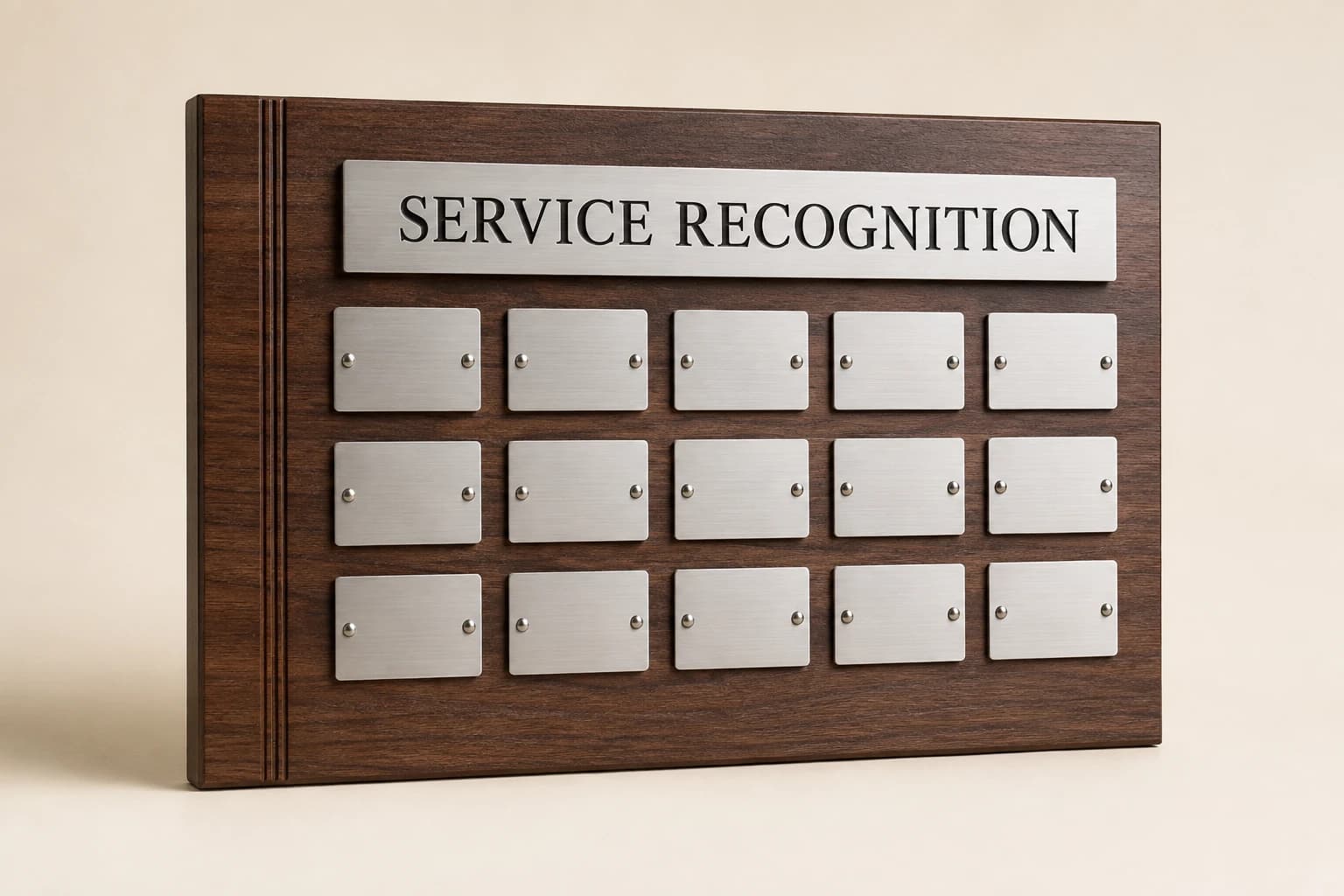
If the object has a limited inscription area, ask the designer to propose a layout that preserves the approved meaning. A shortened statement such as Ten Years can imply a different message from the fuller approved wording. Do not remove qualifying words solely to fit a stock line arrangement; return the proposed edit for approval.
Who resolves an uncertain service statement?
Identify the person or role who can approve the employment-related statement and the person who can approve the award's visual layout. The production contact should know where to send a question about the service line without receiving the entire personnel history.
Record pending decisions in a small exception list with the recipient reference, unresolved field and owner. Keep those rows out of the released production file until their required information is settled. A batch can contain many routine entries and one unresolved message; the exception should remain visible instead of being hidden under a general approved status.
When the decision is made, update the source roster and issue the corresponding proof revision. An email response that is not reflected in the production file can leave the designer working from the old wording. The final released set should identify one current instruction for every physical piece.
Which wording should a replacement reproduce?
Keep the final inscription and design reference for future replacements. The retained award record can state what was approved for this particular occasion without carrying the private reasoning behind the employer's decision. This makes a later request to replace a damaged plaque straightforward.
For a future milestone, seek a new approval instead of assuming the earlier wording establishes a permanent rule. The program, recipient status or intended recognition may have changed. A past award is evidence of its own approved inscription, not authority for the supplier to calculate the next one.
If the recipient asks for a name correction or a different public presentation, route that request through the program's designated owner and keep the accepted change synchronized with the retained design. The replacement should reflect the current approved instruction rather than reproduce an older file by default.
What should you confirm before ordering?
Returning-employee recognition needs a public message approved by the employer’s responsible reviewer. Keep private service-history decisions separate from artwork preparation. The questions below address year counts, appreciation wording, employment breaks and late revisions so the finished piece states what was authorized without exposing unnecessary personnel details.
Does different returning-employee wording need a separate award quote?
Identify each wording group within the same purchase and ask what its personalization and proof work include. Construction, quantity and the extent of individual layout changes affect the quoted scope. Service Year Awards needs approved public service statements, not private employment histories, to describe the actual pieces and design work in writing.
Should service before an employment break count?
That is a decision for the employer’s responsible policy owner. Send the approved milestone or exact service statement to production; the supplier should not decide from raw dates. The instruction should say what this particular award recognizes. A supplier can reproduce the approved inscription without receiving the private reasoning behind an employment-policy decision.
Can we avoid a year count?
Yes, if the program owner approves an appreciation message that fits the occasion. Confirm the exact wording rather than leaving the designer to invent a service claim. An approved message of contribution or appreciation can give the piece a clear purpose. Keep its exact words linked to the recipient and final proof.
Should the break in employment be mentioned on the award?
Include only the public message the organization and appropriate approver have chosen. Internal personnel details should not be copied into artwork simply to explain a calculation. Confirm the public message with its responsible reviewer. A plaque should not reveal private employment circumstances merely because they appear in the source records.
What if the approved wording changes late?
Identify the affected recipient and file revision, confirm the actual production state and obtain a specific response about the change. Update both the roster and proof so one final instruction governs the piece. If permanent work has begun, ask which specific change remains possible. Do not assume that editing the spreadsheet also changes an already released production file.
Sources and scope
The sources below support the cited technical details. The ordering workflows are editorial recommendations. Your project specification, price and schedule are established in the written quote and approved proof.
- Awards.com: Years of Service & Anniversary Awards Guide · checked 2026-09-05
Which buying guide should you read next?
All buying guidesChoose a consistent award family, then give each approved service milestone a clear distinction in wording, presentation or design.
Separate the reusable service-award design from each cycle’s approved recipients, quantities and delivery allocations so a recurring order cannot replay stale personal data.