Service Year Awards · buyer guide
Five-year and ten-year award tiers compared
Compare five-year and ten-year awards through the employer’s approved milestone policy. Service Year Awards helps buyers worldwide turn that policy into distinct inscriptions and coordinated designs. Both tiers can share a design family; the ten-year piece does not automatically need to be larger. Confirm each recipient’s milestone before choosing the physical difference.
Reviewed 2026-09-05 · AI-assisted editorial review. General buying guidance; illustrative scenarios are not customer case studies. Images are AI-generated concepts.
The useful comparison is the complete experience for each recipient: the message, personal name, physical object, packaging and handoff. Keep the program respectful and coherent across tiers. If a ten-year piece uses a different construction, specify that clearly and review it alongside the five-year piece rather than choosing two unrelated products solely because their prices fit separate budgets.
Do service-award product categories define our program?
Awards.com's service-award guide discusses recognition at five years, ten years and later milestones. That merchant example establishes a familiar way to organize a product range; it does not define your employer's policy or demonstrate a particular retention outcome for these awards.
For your program, write down the milestones actually approved for the current cycle. A company might recognize five and ten years, or use a different schedule entirely. Include the date on which eligibility is assessed and the person responsible for confirming the roster. The supplier should receive the approved milestone for each recipient rather than calculate employment history from raw dates.
Keep a design tier separate from a service-history rule. If the organization changes how it counts a particular period of employment, that is a policy decision to resolve before inscription approval. The product choice should express the approved result, not determine it because a convenient catalog option happens to say ten years.

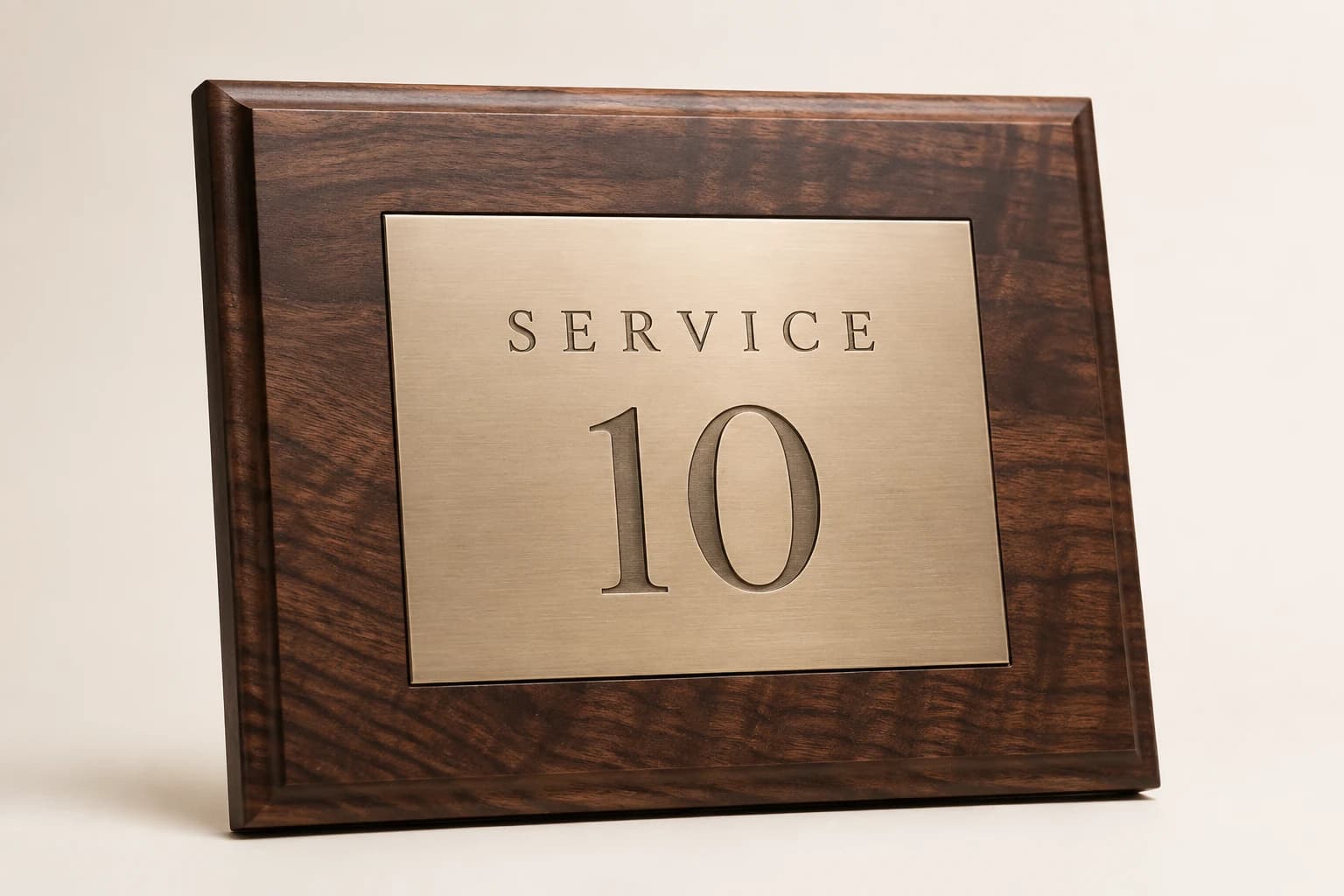
Sources: Awards.com: Years of Service & Anniversary Awards Guide
What should stay consistent across milestone designs?
Choose a common element such as the program title, logo treatment, overall silhouette or inscription hierarchy. That connection helps the pieces read as one recognition system even if their material or size differs. Ask for a paired concept showing both tiers together rather than approving each in isolation on a separate screen.
Then identify the distinction that matters. You could propose a different milestone line, a selected accent or a reviewed change in presentation. A change in material may also be considered, but its cost, weight and practical handling should be evaluated in the actual proposed construction. Do not assume that one material name automatically makes an award more meaningful to its recipient.
Keep future milestones in mind without ordering them prematurely. The selected family should leave room for a later design conversation if the program adds another tier. Retain the approved files and principles so that a future coordinator can understand why the five-year and ten-year pieces differ, rather than reverse-engineering the system from old photographs.
Review where the recipient is likely to display each tier. A desk piece and a wall plaque ask different things of the recipient, even if the program artwork matches. State any practical constraint the organization wants considered, such as an available display area or the need to transport the piece after a ceremony. Ask production to propose dimensions and construction against those requirements. Do not select a larger ten-year object first and assume its owner will have a suitable place for it. The tier distinction should remain deliberate after the award leaves the presentation table.
What should each service-award inscription say?
Use the approved display name and milestone wording as distinct fields. A concise line such as Five Years of Service can identify the occasion, while another approved line expresses the organization's appreciation. Keep the employer's exact preferred style for numerals, capitalization and dates consistent across the tier.
Do not put an unverified start date on the piece merely to make the inscription longer. If the program wants a date range, have the responsible source owner approve the exact dates and what they represent. A presentation date, an employment anniversary and a program cutoff date can be different values.
Review representative names on both designs. A ten-year piece with more decorative detail may have less usable engraving area than a simpler five-year plaque. The milestone distinction should not make a long recipient name unreadable or force an unauthorized abbreviation. Resolve layout exceptions using the actual approved strings before releasing the batch.


Illustrative example: how many pieces do eighteen and seven recipients need?
Imagine a fictional program with eighteen approved five-year recipients and seven approved ten-year recipients. Each receives one personal award. The physical order is 18 + 7 = 25 pieces, with no assumed extras. The two tiers may use different approved designs, but the roster-to-design mapping must preserve which recipient belongs to which milestone.
In the optional calculator linked below, enter those two groups and confirm twenty-five pieces. The downloadable worksheet separates the tier, recipient count, pieces per recipient and design reference. Its references are fictional placeholders, not existing production files. A real order needs the exact approved names and current design revisions behind the summary.
Suppose two of the ten-year recipients will receive their pieces at a later office event. The order remains twenty-five if their eligibility and quantities stay unchanged. The shipping or handoff allocation changes: five ten-year pieces for the main event and two for the later event. Keep that allocation separate from the milestone count.
If the program adds one shared recognition display, that is an additional object with its own purpose and inscription. The total becomes twenty-six. Do not hide it inside a tier's recipient count or let the supplier assume that every group automatically includes a department display. Explicit quantities make the scope reviewable and the quote comparable.
Ways to distinguish milestones
Distinguish service milestones through the inscription, related design variants or the presentation arrangement the employer approves. Changing material, size or packaging changes the purchase in different ways. Compare both complete tier specifications together, and keep any shared display separate from the personal pieces included in the recipient count.
| Option | What this option establishes | What remains a separate decision |
|---|---|---|
| Same design with different milestone text | A consistent family with a clearly stated service period. | Whether the organization wants an additional physical distinction. |
| Related designs in different sizes | A visible tier difference within one approved design language. | Actual engraving area, handling and cost of each construction. |
| Different materials in one family | A proposed material distinction linked by common artwork. | Whether the complete objects meet the program’s practical and visual priorities. |
| Different presentation packaging | A change in the handoff while the core object remains related. | What packaging is actually included and suitable for onward travel. |
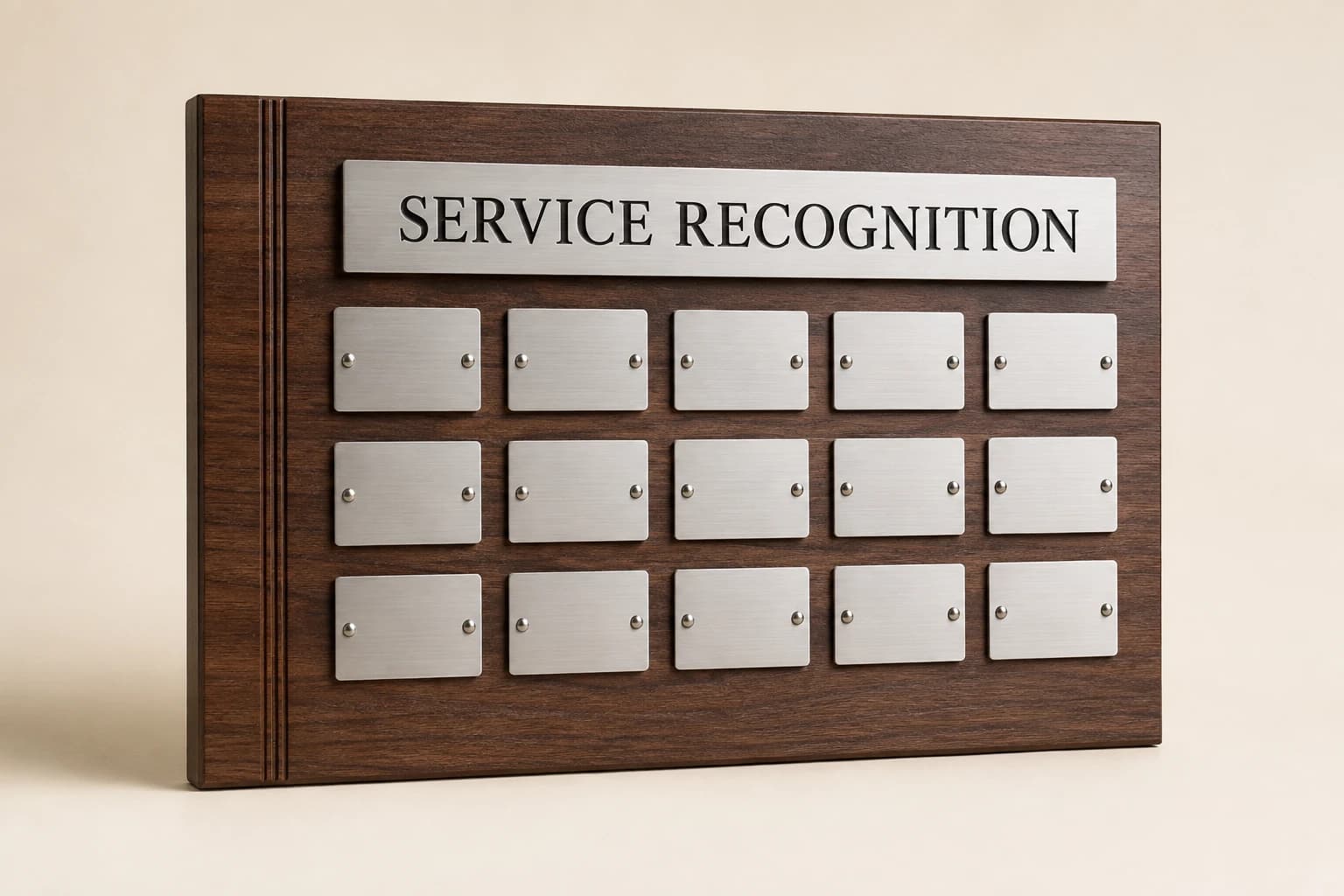
| Shared display plus personal pieces | An organizational record alongside individual recognition. | Separate ownership, update method and object count. |
Use the article’s example files
The file contains fictional groups and approval placeholders. Replace them with your authorized program records; it is not a source of employee eligibility or personal information.
What should a service-tier quote include?
Ask the quote to separate the quantities and selected construction for each tier. Include personalization, setup, requested packaging and delivery allocation in the described scope. A price per award may not include the same services across two proposed products, so reconcile the included work before comparing the totals.
Use current written prices or clearly labeled planning assumptions in a budget exercise. There is no universal multiplier that makes a ten-year award correctly priced relative to a five-year award. The program owner should choose a budget and intended experience, then evaluate proposals against those requirements.
If a budget change is needed, revise the design or scope explicitly. Simplifying a decorative detail may preserve the intended recognition, while removing a personal piece changes what someone receives. Review the effect on the whole program rather than treating every reduction as an equivalent saving.
Who approves milestone assignments and names?
Prepare one release record identifying the roster revision, design for each milestone and physical quantities. Have the program owner confirm the milestone assignment and the appropriate reviewer confirm the exact inscription. A designer can check how the text is arranged, but should not decide which service tier an employee has earned.
When a correction changes a recipient's tier, update the design allocation as well as the text. Changing Ten to Five in an inscription may not be enough if the program uses different physical designs. Reconcile the quote, proof and packing references so all three describe the revised order.
After receiving the pieces, check the mixture rather than only the total of twenty-five. The correct grand total can still contain the wrong number in each tier or a name assigned to the wrong design. Retain the approved set for reorders, and keep any accepted correction synchronized with the source record.
What should you confirm before ordering?
Before ordering service tiers, settle how the two milestones differ and who approves each recipient’s assignment. Cost comparisons need the complete award specification for both groups. The questions below cover size, shared designs, office consistency and corrections so an attractive paired concept also matches the employer’s actual recognition decision.
How should we compare five-year and ten-year award costs?
Compare a price per complete award for each approved tier, then list personalization, setup, presentation packaging and delivery separately where they add cost. Material, dimensions and the quantity in each tier can change the quote. Service Year Awards needs the two design scopes and recipient counts to produce a meaningful written comparison.
Must a ten-year award be larger than a five-year award?
No universal product rule requires that. Choose a distinction that fits the approved recognition program, then review both complete designs together. The milestone should remain clear in the wording. A larger base, different finish or changed presentation box is a separate specification choice, not evidence that the milestone was assigned correctly.
Can one design serve both milestones?
Yes, if the program approves that approach and the text clearly identifies each milestone. Keep the exact tier assignment in the roster and review the personalized proofs. Review a paired proof so the common logo and program treatment remain consistent while the service-year line clearly distinguishes the two groups.
Should recipients in different offices get different award quality?
Set the intended recognition experience through the program owner. Delivery needs may differ, but geography alone should not silently change the approved design or message. Record any deliberate difference in construction or presentation before release so the receiving office cannot silently substitute another product for convenience.
What should happen if a service-year calculation changes?
Have the responsible employer contact approve the corrected milestone, then update its wording, design allocation and order records. The supplier should not infer the policy from raw employment dates. Identify the affected recipient reference and supersede the earlier proof. Reconcile both tier totals so correcting one person does not create a duplicate piece.
Sources and scope
The sources below support the cited technical details. The ordering workflows are editorial recommendations. Your project specification, price and schedule are established in the written quote and approved proof.
- Awards.com: Years of Service & Anniversary Awards Guide · checked 2026-09-05
Which buying guide should you read next?
All buying guidesUse the employer’s approved service wording for returning employees, with appreciation language that does not imply an unconfirmed period of continuous employment.
Separate the reusable service-award design from each cycle’s approved recipients, quantities and delivery allocations so a recurring order cannot replay stale personal data.