Service Year Awards · specification guide
Coordinate service awards across international teams
Keep service eligibility, inscription approval and delivery instructions in separate records linked by a recipient reference. A global service-award order needs a consistent milestone rule, a respectful name layout and a receiving plan for each team. Confirm those details before approving a batch.
Reviewed 2026-09-05 · AI-assisted editorial review. General buying guidance; illustrative scenarios are not customer case studies. Images are AI-generated concepts.
Choose the construction before counting the shipment
A recognition calendar can look uniform while the underlying employment records use different anniversary conventions. Let the program owner approve the milestone and the exact public wording; the designer should not infer tenure from a spreadsheet of start dates. Decide whether each employee receives the same format, a tiered format or a choice of display styles. A personal address plaque, office wall plaque and desk award create different handoff needs even when their messages recognize the same number of years.

A worked quantity example
Illustrative order: a program recognizes 18 people at five years and six at ten years. Two of those recipients attend an overseas team meeting. There are still 24 recipients, not 26; the meeting changes where two pieces go. Use one roster row per person and a separate destination column. If the business also wants one team thank-you plaque, add an explicitly shared row and raise the total to 25. Count optional presentation boxes separately so a packaging line cannot be mistaken for another award.
Compare relevant design starting points
The catalog offers different starting points for this brief. Compare the intended use and proposed specification below, then ask which construction and included components fit your own receiving and display plan. These are design proposals, not measured packed goods.
| Option | Intended use | Proposed material and size | Personalization |
|---|---|---|---|
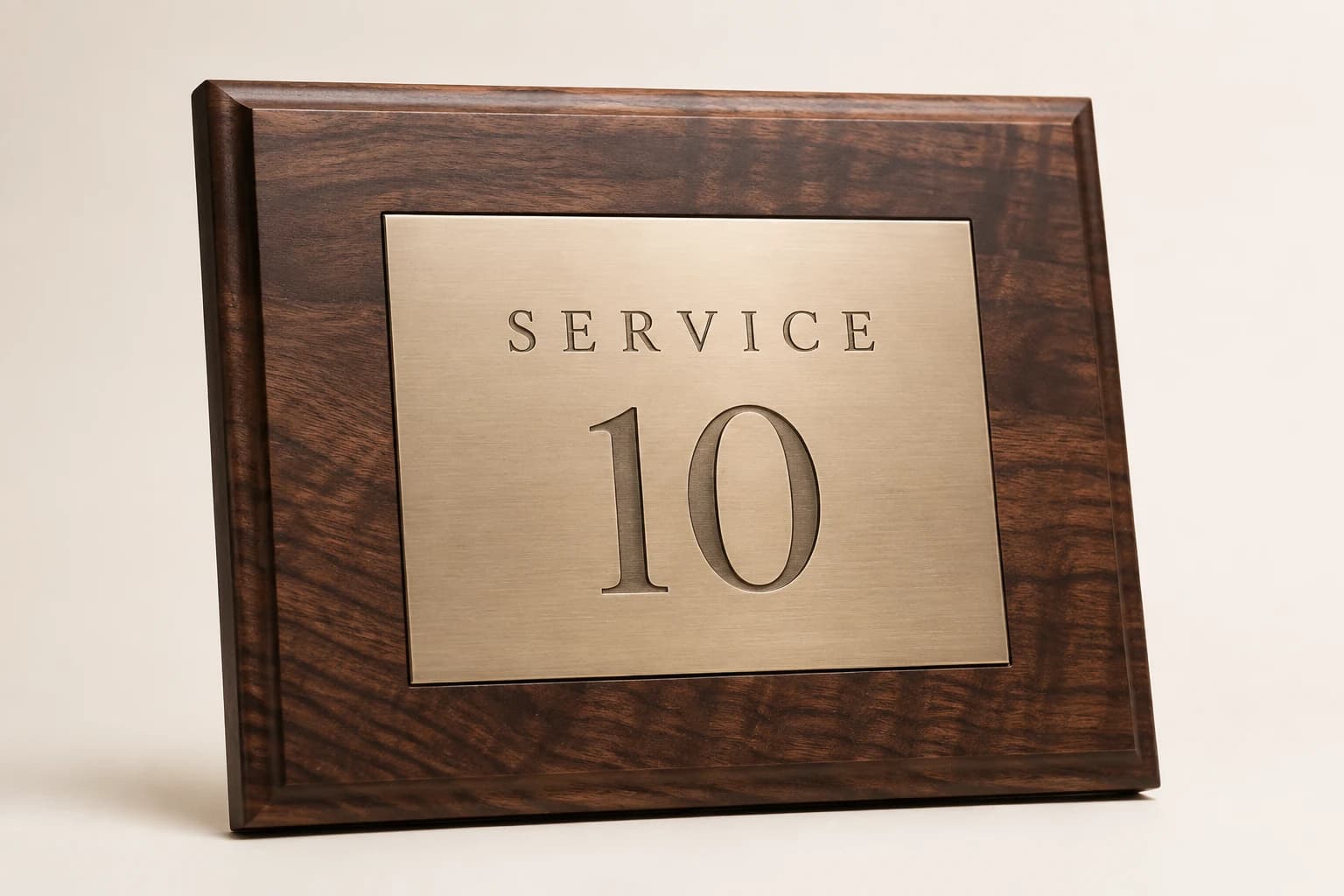
| Service Milestone Plaque | Show the continuity behind a career. The service plaque pairs walnut with brushed metal for a service milestone, with the employee's name and years receiving equal attention. | Walnut and brushed metal. 8 × 10 in | Employee; Milestone; Service years; Message |
| Employee of the Month Acrylic Award | Build a monthly recognition tradition people can display on their own desks. The acrylic format keeps the person's name prominent beneath the program title. | Clear acrylic. 7" H | Employee; Program; Month; Contribution |
| Team Appreciation Award | Celebrate the group effort behind a successful year, launch or difficult assignment. This shared award centers the team name and the achievement they can take pride in. | Acrylic and metal. 12" H x 10" W | Team; Achievement; Project; Year |
| New Hire Desk Nameplate | Give a new colleague a welcome that belongs on their desk. A personalized nameplate makes the first workspace feel prepared for the person joining the team. | Acrylic, metal, or wood. 8" x 2" | Name; Title; Team |
When to consider Service Milestone Plaque
Use the same format across a service program and vary the milestone inscription. A five-year and a twenty-year award can belong to the same visual family while carrying different messages about the person's contribution.
Example layout fields: Employee: Alex Rivera; Milestone: 15 Years of Service; Service years: 2011–2026; Message: Thank you for the care you bring to every day. The names and wording are illustrative. Open this design from the collection to replace them with your approved information.
When to consider Employee of the Month Acrylic Award
Include the month and year so the award remains meaningful after the next recipient is announced. If the recognition is for a particular action, add a short contribution line instead of filling the remaining space with generic praise.
Example layout fields: Employee: Jordan Kim; Program: Employee of the Month; Month: September 2026; Contribution: For helping the team deliver. The names and wording are illustrative. Open this design from the collection to replace them with your approved information.


When to consider Team Appreciation Award
Choose a shared display location before choosing the wording. A team-room award can name the whole group, while individual desk versions can recognize each person's role without crowding the main piece.
Example layout fields: Team: Client Experience Team; Achievement: Together We Made It Happen; Project: The Welcome Project; Year: 2026. The names and wording are illustrative. Open this design from the collection to replace them with your approved information.
When to consider New Hire Desk Nameplate
Use the person's preferred professional name and decide whether to include a title. For a group of new starters, a consistent format creates a coordinated workspace while leaving room for names of different lengths.
Example layout fields: Name: Avery James; Title: Client Success; Team: Northline. The names and wording are illustrative. Open this design from the collection to replace them with your approved information.
Keep the piece count separate from the delivery plan
Use recipient reference, approved milestone, name as it should appear, distribution team as the project-specific headings in the specification file. Add a stable row reference, the quantity of physical pieces and a receiving group. If two pieces share artwork but go to different destinations, keep separate delivery rows. If one person intentionally receives two different awards or signs, preserve both product rows. Repeated names alone are not an error.
The worksheet below totals the pieces you enter and reconciles them by receiving reference. It does not infer how many packages will be needed. One large assembly can require more than one package, and several small pieces may share a package when the final packing plan permits it. Ask for the packed dimensions, weights and component list after the construction is settled. Keep the receiving group names consistent; two slightly different labels are treated as two groups.
Use one controlling unit on the drawing
One inch equals exactly 25.4 millimeters. The worksheet converts entered width and height using that relationship and keeps the original values visible. A converted display is a convenience for review; it does not create a fabrication tolerance or certify physical fit.
Specify whether a measurement describes the overall assembly, the visible face, the engraving area or an opening in an existing holder. Include thickness, depth, hole spacing and support clearances separately when they matter. Do not round a metric opening into a convenient inch size and assume the fit is unchanged. Identify which drawing and measurement control when two references disagree, and have the responsible project contact resolve that disagreement before the proof is released.
Sources: NIST: SI units: length
Proof names and language without changing their meaning
Personal naming conventions vary across cultures. Keep the exact display text supplied by the person approving it, including accents, punctuation and name order. A shipping contact may use a different form of the name from the inscription; the artwork should not be overwritten by an address record.
For several languages, provide each approved version rather than asking the production file to translate itself. Review the longest lines, the intended reading order and any script-specific layout in the actual proof. A typed sample is useful for wording approval, but it does not establish which font or marking method will reproduce it clearly. Use an unambiguous written date or identify the intended numeric date convention. Keep the accepted text and proof revision together so later edits can be traced.
Sources: W3C: Personal names around the world
Reconcile the quantities and prepare a private brief
Enter groups of matching pieces below. Add a receiving reference and optional width and height, then review the total and the unresolved quote details. The examples above are illustrative; replace them with your own order information. No automatic spares, discounts, freight costs or delivery promises are added.
Method: Sum positive whole-piece quantities, group by the exact receiving reference and convert optional dimensions using 25.4 millimeters per inch. No spare pieces are inferred. Display conversions use at most four decimal places and do not establish manufacturing tolerances. Customs, freight, origin and arrival timing remain quote questions.
Build your international order brief
Add groups of pieces sharing a specification and receiving destination. Use an office, venue or country reference here; street addresses are not needed for this planning step. Quantities are pieces, and delivery groups are not parcel counts.
Compare the complete written order, in a stated currency
Ask each option to identify the product quantity and what is included: personalization, new artwork, tooling, presentation packaging, mounting parts or assembly work. Keep one-time charges separate from recurring piece charges so a future reorder can be discussed accurately. A starting price for a small component is not the price of a complete display. Compare the alternatives against the same approved brief before deciding that one total represents a saving.
Record the currency code next to each quoted amount. Do not combine a product estimate in one currency with a freight amount in another without an explicit conversion source and date. Ask the quote to state the freight service, any quoted import charges and the party responsible for charges that are not included. The worksheet records your requested arrangement, which still needs written confirmation. It calculates no selling price, exchange rate, tax rate or customs charge.
Confirm shipment details for the actual destination
Commercial invoices identify goods, quantities and values. Ask the shipping contact to confirm the accurate product descriptions, origin information and other documentation required for the particular shipment. This guide and its worksheet are planning aids, not customs declarations.
Give the quoting team the receiving country and the actual destination details through the order process. Confirm the ship-from location, the available service and who will answer delivery or import questions. Do not infer the origin of the goods from the storefront name or assume that an event gift has no reportable value. Keep production completion, carrier transit and the requested in-hand date as separate milestones in the written plan. The receiving date you enter below is a request, not a calculated arrival commitment.
Prepare the handoff and the receiving check
Label the inside presentation package using the approved recipient reference and milestone. Group the shipment by the person distributing it, which may differ from the employee's usual office. Preserve the accepted layout, finish direction and date convention for the next recognition cycle. A saved order record supports a precise reorder request; it does not lock future freight, material availability or pricing.
Before distribution, match the delivered piece references and component counts to the approved schedule. Check the wording against the accepted proof and keep the packaging while any discrepancy is being reviewed. Identify the affected row, proof revision and photographs when requesting help. Preserve the order record for replacements or a repeat event; a later order still needs its own confirmed specification, price and schedule.

Collection planning overview
This existing narrated collection overview provides background for the design choice. Use the international worksheet and the receiving schedule in this guide for the delivery brief. The visuals are original design concepts rather than footage of completed shipments.
25-second overview
Plan an employee recognition program that is easy to repeat
Start with the milestones your program recognizes. Agree on the service-date convention, then map each tier to a design. Keep recipient names separate from the reusable artwork. Check long names, assign packing groups and save the approved design reference. Use that record to request a clear quote for this cycle and future additions.
Prepare your brief and request a written quote.
Questions before the order is released
Does one delivery group mean one parcel?
No. A delivery group connects pieces to a receiver or location. The final construction, packed dimensions and protection determine the package plan. Ask for the actual parcel or freight details in the quote.
Does entering a country confirm delivery service?
No. The worksheet records the destination you want quoted. The order team confirms service for the actual address, shipping arrangements and timing in the written quote.
Will the worksheet add spare pieces or discounts?
No. It adds only the quantities you enter. Create an explicit spare-pieces row if you want extras, and keep personalized pieces separate from blanks. Any discount belongs in the written quote.
Which project details should accompany this brief?
Include recipient reference; approved milestone; name as it should appear; distribution team. Keep the exact approved text and the physical specification linked to a stable row reference, then identify the receiving group for each piece.
Turn the schedule into a specific quote request
Choose a design, reconcile the physical pieces and include the decisions that remain open. The quote team can then review the construction, artwork, packing and delivery requirements as one defined project. Save the worksheet result with your approved source files so a later change can be applied to the correct group.
Sources and scope
The sources below support the cited technical details. The ordering workflows are editorial recommendations. Your project specification, price and schedule are established in the written quote and approved proof.
- NIST: SI units: length · checked 2026-09-05
- W3C: Personal names around the world · checked 2026-09-05
- UPS: How to create a commercial invoice · checked 2026-09-05
Which buying guide should you read next?
All buying guidesSeparate the reusable service-award design from each cycle’s approved recipients, quantities and delivery allocations so a recurring order cannot replay stale personal data.
Preserve the recipient’s approved full display name and adjust the design around it, using actual-size proofs rather than a character limit as a fit guarantee.
Choose whether the photograph should remain a separate replaceable component or part of the finished recognition artwork, with a clear image window, inscription area and update responsibility.
Choose a consistent award family, then give each approved service milestone a clear distinction in wording, presentation or design.